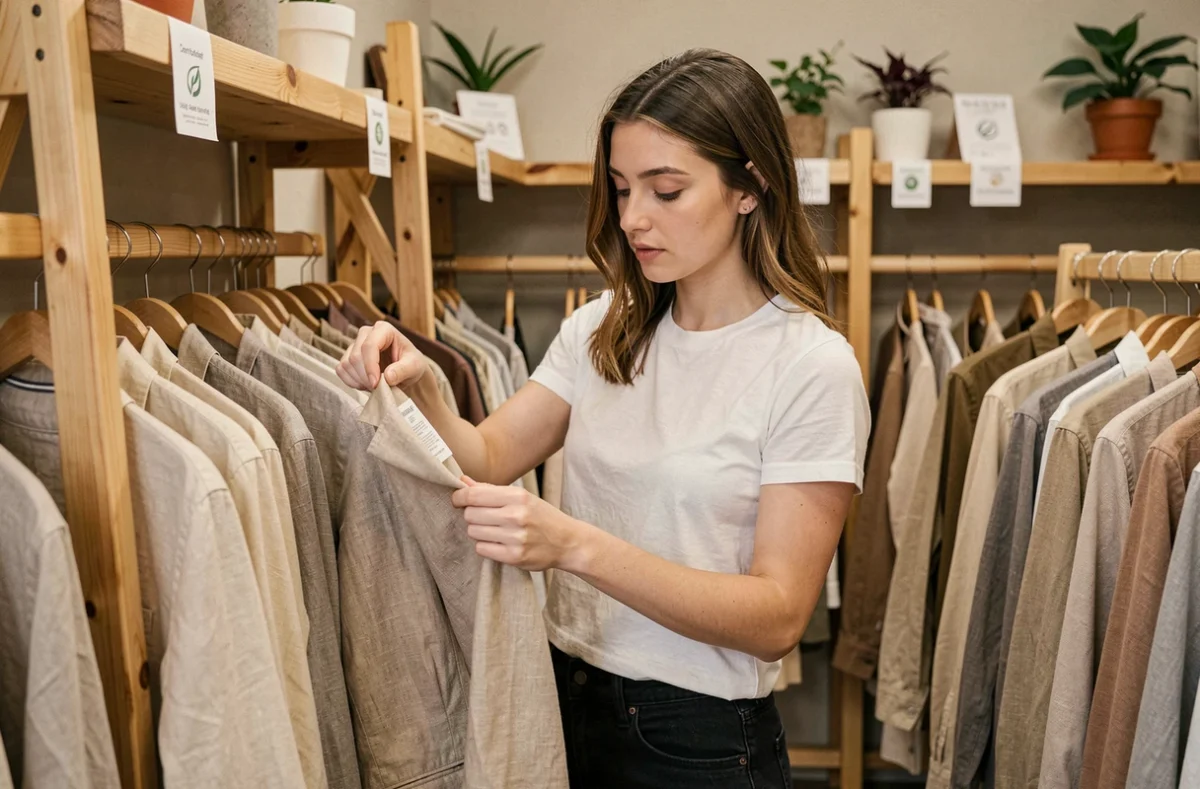
An organic cotton T-shirt, a green logo on the label, a promise of a “responsible collection”: these signs are reassuring at first glance. Yet they reveal almost nothing about the actual conditions under which a garment is made. Identifying controversial retailers and choosing brands carefully means looking beyond marketing claims to examine concrete, verifiable evidence—some of which may be counterintuitive.
Textile greenwashing: the superficial tactics to see through
Have you noticed a retailer promoting an “eco-responsible line” of ten items, while its catalogue contains several thousand? This is one of the most common tactics. Labelling a tiny fraction of a collection can be enough to green a brand’s overall image without changing the rest of its production.
Three phrases commonly found on product pages and in advertising campaigns deserve particular scrutiny:
- “Recycled materials” without specifying the actual percentage in the finished garment. A fabric containing only a small proportion of recycled fibres may still carry this claim.
- “Responsibly made” without reference to external standards or an independent audit. The phrase makes no specific legal commitment.
- “Committed to the planet” or “conscious collection”—expressions that reflect marketing positioning, not certification verified by a third party.
To consult the list of brands to boycott because of documented controversial practices, cross-check several sources: NGO reports, journalistic investigations and publicly released audit results. A single negative finding is not enough to condemn a retailer, but a growing number of warnings is a serious reason for concern.

Environmental impact and transparency: what new tools are changing
Since 1 October 2025, brands selling clothing in France have been able to display an “environmental cost” calculated using the Ecobalyse tool. This score covers several stages in a product’s life cycle and different types of impact.
This score does not measure working conditions. It assesses environmental impact, not social performance. Distinguishing between these two dimensions helps avoid assuming that a good environmental score guarantees ethical manufacturing.
Voluntary disclosure, not a requirement
The scheme remains optional. A brand that does not display the score is therefore not necessarily suspicious. Conversely, a retailer that publishes it does not automatically prove its virtue: environmental cost is one indicator among many, not a seal of good conduct.
In practice, the tool makes it possible to compare two similar products (two pairs of jeans, two sweaters) using a common methodology. Associations, comparison sites and consumers can also use it to question retailers that do not provide information about their products.
However, a score based on estimated or incomplete data should be treated with caution. Check whether the brand explains the assumptions used in the calculation.
Practical criteria for assessing a clothing brand
Rather than searching for the perfect brand, it is more realistic to apply a set of criteria to each retailer. Here are the most telling points.
Supplier traceability
A brand that publishes a list of its factories, including their names and locations, offers a verifiable level of transparency. Disclosing tier 1 and tier 2 suppliers remains the most reliable sign of transparency. When this information is entirely absent, it becomes impossible to verify anything about production conditions.
Labels and certifications: what to check
A reliable label is based on publicly available standards, audits by an independent body and regular checks. GOTS (for organic cotton) and Oeko-Tex (for limiting harmful substances) certifications meet these criteria.
A label awarded by the brand itself has no certification value. If the logo displayed cannot be linked to an organisation that can be verified online, it is probably an internal marketing tool.
Managing unsold stock and inventory
European regulations are increasingly addressing the issue of unsold textiles. Looking at how a retailer handles surplus stock (donation, recycling or destruction) often reveals more about its actual practices than its promises about raw materials.
- Does the retailer disclose the volume of its unsold stock and how it is handled?
- Does it offer a take-back or repair programme for its own products?
- Is its collection schedule (the number of new items released each year) compatible with a commitment to reducing waste?

Responsible fashion in everyday life: making choices without guilt
Choosing brands carefully does not mean buying only from high-end certified labels. It starts with reducing the number of new items you buy and making the clothes you already own last longer.
Buying second-hand, repairing clothes and renting are practical alternatives that reduce pressure on the textile supply chain, whatever your budget. A garment worn for a long time—even one from an imperfect brand—has less impact than an “eco-responsible” garment worn three times.
Being discerning also means accepting a reality: no brand ticks every box. Looking at transparency, traceability and inventory management together gives a more accurate picture than a single label on a tag. Applying this combination of criteria to every purchase is what can shift a wardrobe towards genuinely more responsible consumption.